


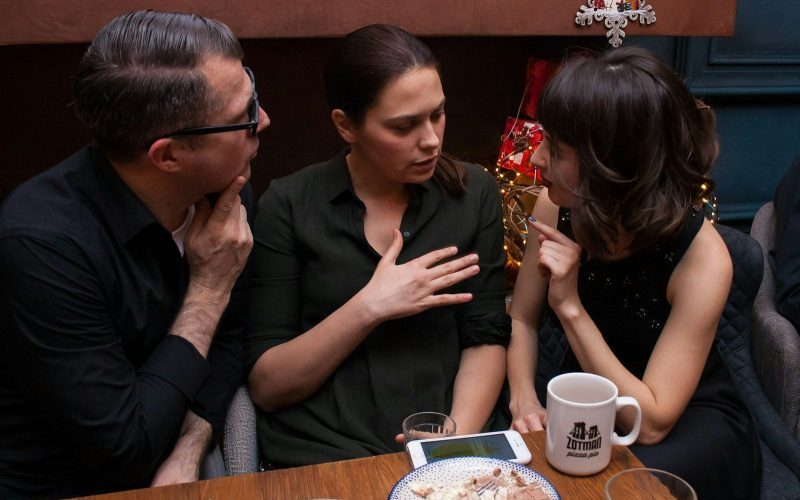
Tell someone you don’t want children and you may accidentally have requested a psychological assessment. Perhaps you’re afraid of responsibility. Perhaps your childhood needs investigating. Perhaps you haven’t met the right person, whose reproductive enthusiasm will apparently overwrite your personality. Somewhere in this conversation, someone who has known you for eleven minutes becomes very confident about what will make you happy at sixty. You were discussing your plans for the weekend and suddenly they are supervising your life.
Underneath these exchanges sits the persistent assumption that wanting children is self-explanatory and not wanting them requires an explanation, preferably one that reveals something wrong with you. You might even get gaslit into wanting to know what research on childfree adults has to say about it. Do people who don’t want children differ psychologically from people who do? Are we looking at a distinctive personality, a different set of priorities, or a collection of perfectly ordinary people whose reproductive decisions have upset the seating plan? The findings give considerably less reason for concern than the unsolicited advice would suggest.
First, Are We Even Studying the Same People?
Before getting into them, though, we need to distinguish people who don’t want children from people who wanted them and couldn’t have them. Both may appear under “no children” on a questionnaire, but that shared answer tells us very little about their experience. Someone grieving a hoped-for family and someone delighted never to attend a school parents’ evening are not describing the same life. Research that combines them can blur precisely the difference we need to understand: whether someone’s circumstances correspond to what they wanted. The literature repeatedly identifies this distinction as essential to interpreting findings about well-being [1,2].
Once we make that distinction, the fantastic story of the secretly miserable childfree adult becomes harder to sustain. Studies find no meaningful differences in life satisfaction between childfree adults and parents, or other groups of nonparents [3]. Treating eventual misery as the predictable consequence of declining parenthood is far of, just like establishing that childfree people are happier, wiser, or better at being alive. You can be thoroughly pleased about not having children and thoroughly displeased with your job, your relationship, or your own behavior last Monday. A reproductive decision cannot organize the rest of your psychology for you. Equally, a miserable week doesn’t expose your childfree life as a terrible mistake. Parents are generally allowed to have a bad days without someone suggesting that the existence of their children explains it. The same courtesy would be lovely.
A Personality Type? Hold the Matching Jackets
Personality findings are more mixed than a neat “childfree personality” profile would suggest. Research shows that childfree respondents score higher on independence and lower on agreeableness and extraversion than parents or people who wanted children [4]. That is interesting, although it leaves the direction of the relationship unresolved: these results don’t show that choosing a childfree life makes you independent, or that independence necessarily leads you away from parenthood. After demographic adjustments, no significant personality differences between childfree adults and parents remain, though; the only difference persisting is the slightly lower agreeableness among childfree adults compared with people planning to become parents. So sadly, however convenient that would be for writing a punchy article, sharing a decision about parenthood does not give us a shared personality. We could nevertheless commission matching jackets for the fiercely independent, gloriously disagreeable childfree population [3].
Your Decision, Their Moral Outrage
Where the research does get more revealing is in how people respond to that decision. If you ask people to evaluate a married adult described as having chosen either no children or two children, the childfree adults elicits moral outrage and are judged less fulfilled. This applies to both male and female targets [5]. Notice what is being measured: other people’s judgments about someone’s fulfillment. Nobody needs to establish that these fictional childfree people are spending their evenings weeping into decorative cushions, it’s simply assumed that childfree adults are less fulfilled. The moral outrage is unfounded: disliking someone’s preference is one thing; responding as though they have failed an obligation is another. Research shows that parenthood can function as a moral expectation, making refusal look like a breach of duty. It offers an confirmation of the experience in which your explanation is heard and rejected because you are apparently not entitled to want that.
Apparently, Your Future Has Already Been Decided
Then comes the future: You’ll regret it. You’ll be lonely. Who will look after you? Research on regret makes an important distinction between people who chose not to have children and those who wanted them. Voluntarily childless women report greater well-being, more autonomy, and a stronger sense of being able to manage their lives than involuntarily childless women. They were also not likely to report child-related regret [1]. The social setting also matters. A study of 24,195 adults over forty across 24 European countries found that the association between childlessness and poorer psychological well-being varied between countries, particularly among women. The disadvantage was smaller in countries where attitudes toward childlessness were more accepting and social contact was more common [6]. This study examined childlessness broadly, however, so its findings cannot be attributed specifically to childfree people.
A Final Note: You also Don’t Owe Anyone an Extraordinary Life
The research gives us little reason to treat a childfree life as inherently less fulfilling. My additional note is that you also shouldn’t have to prove its value by becoming exceptionally accomplished, permanently available to your friends, or impressively useful to society. You can care for people without becoming a parent, but you shouldn’t have to submit a portfolio of alternative caring activities before your decision is accepted. The same goes for enjoyment. You do not owe anyone evidence of a sufficiently fabulous life. If you spend a Saturday doing laundry and watching something mediocre, you have not squandered your freedom. You are allowed an ordinary life, including its less photogenic uses of an afternoon.
That freedom from having to justify yourself matters in psychoanalysis, too. Your decision about children can be explored, but only with the same neutrality as other consequential choices and zero quiet appointments of parenthood as the correct outcome. You may have mixed feelings about having children, feel pressure from your family, or want to understand how you approach commitment and independence in other parts of your life. Or you may be perfectly fine about not wanting children and prefer to discuss something else. You don’t want children. It would be lovely if that could occasionally be the least interesting thing about you.
Sources
[1] Jeffries, S., & Konnert, C. (2002). Regret and psychological well-being among voluntarily and involuntarily childless women and mothers. The International Journal of Aging and Human Development, 54, 89–106. https://doi.org/10.2190/J08N-VBVG-6PXM-0TTN
[2] Stahnke, B., Cooley, M. E., & Blackstone, A. (2022). A systematic review of life satisfaction experiences among childfree adults. The Family Journal. https://doi.org/10.1177/10664807221104795
[3] Watling Neal, J., & Neal, Z. P. (2021). Prevalence and characteristics of childfree adults in Michigan (USA). PLOS ONE, 16(6), e0252528. https://doi.org/10.1371/journal.pone.0252528
[4] Avison, M., & Furnham, A. (2015). Personality and voluntary childlessness. Journal of Population Research, 32, 45–67. https://doi.org/10.1007/s12546-014-9140-6
[5] Ashburn-Nardo, L. (2017). Parenthood as a moral imperative? Moral outrage and the stigmatization of voluntarily childfree women and men. Sex Roles, 76, 393–401. https://doi.org/10.1007/s11199-016-0606-1
[6] Huijts, T., Kraaykamp, G., & Subramanian, S. V. (2013). Childlessness and psychological well-being in context: A multilevel study on 24 European countries. European Sociological Review, 29, 32–47. https://doi.org/10.1093/esr/jcr037
[7] Teerawichitchainan, B., Kim, D., & Ho, C. (2024). Childlessness, social network profiles in midlife and late adulthood, and their implications for subjective well-being. The Journals of Gerontology: Series B, 79. https://doi.org/10.1093/geronb/gbae055
Leave a Reply